.webp)

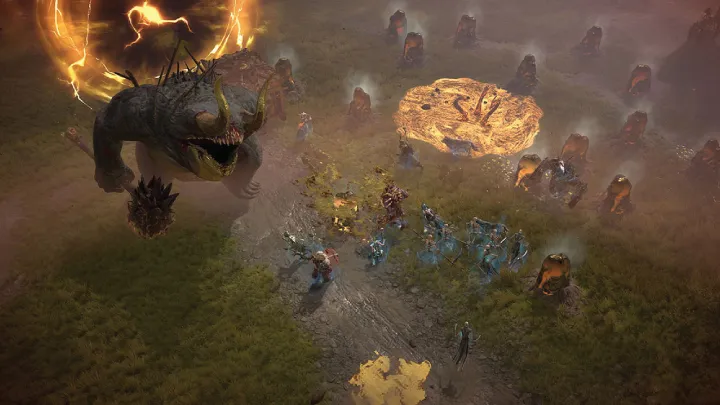
Diablo IV is often described with broad strokes—buildcrafting, loot chase, seasonal rhythms—but the moment you spend enough time in the late-game, you start noticing a specific pattern that shapes your behavior more than any tooltip does. In practice, many players don’t “choose” their endgame. They fall into an ecosystem: a repeatable rotation of activities driven by (1) which bosses drop meaningful items for their build, (2) how reliably those bosses can be reached and cleared, and (3) how often the game’s loot and progression systems make those clears feel productive rather than wasteful. That ecosystem can be efficient—but it can also become psychologically constraining.
This article doesn’t cover Diablo IV in general. It focuses deeply on one specific issue that emerges from the game’s structure: the way the most effective endgame loot loop funnels players into a narrow “boss rotation,” and how that rotation can feel like a lock-in problem—limiting experimentation, compressing build discovery, and creating a sense of sameness even when the content is technically varied. I’ll explain the mechanics behind it, the design incentives that produce it, what it does to player decision-making over time, and which outcomes it tends to generate during seasons. I’ll also point to observable “tells” you can look for when you recognize this problem in your own play.
1) The Core Incentive: Why “Efficiency” Becomes the Real Meta
In Diablo IV’s endgame, “meta” often looks like builds: guides, skills, and stat priorities. But the deeper meta is not a build—it’s time-to-reward. When your character is strong enough to clear quickly, the game starts rewarding you most for high-frequency, low-friction farming. That means your choices gradually optimize toward activities that combine short commitment windows with predictable returns. Over hours and days, this pushes players toward an implicit rotation: a set of bosses and related events that are reliably fast to reach and are commonly associated with target item types or progression steps.
Here’s the problem: once one rotation becomes “the safest path” toward meaningful gains, experimentation starts competing with opportunity cost. You can try a different content type, but the mental calculation is often immediate: Will this be slower? Will I get fewer useful drops? Will it be harder to convert those drops into progression? Even if the new activity is fun, the rotation remains the baseline. That’s how an issue forms—not because the other activities are “bad,” but because the incentives make them feel like side quests.
The loop is behavioral, not mechanical
The rotation isn’t only produced by boss loot tables. It’s produced by multiple interacting systems:
- Travel time and setup time (getting to the fight, preparing builds, and managing resource states)
- Kill speed (how consistently the build melts the content)
- Conversion mechanics (how well drops turn into target stats)
- Run-to-run variability (how often you hit the “good” outcomes that justify the next run)
When those variables align, the boss rotation becomes a self-reinforcing machine. Players who optimize it feel rewarded, which encourages more optimization.
“Most efficient” becomes “most available”
A rotation also becomes attractive because it’s always available. If a boss activity is gated by schedules or inconsistent access paths, the player’s routine breaks. But when access is straightforward and clear, the rotation feels like the default. That default then competes with novelty.
2) The Specific Issue in Detail: Boss Rotation Lock-In
Let’s define the lock-in problem precisely. Boss rotation lock-in is what happens when the endgame’s most reliable “loot + progression” loop is narrowly concentrated around a small set of boss encounters. Players can still engage with other systems—world events, dungeons, alternate content routes—but their primary reward expectation comes from that rotation. Over time, the game produces a “living route” that many players repeat even when new content appears.
This isn’t merely boredom. It’s a design consequence of how players measure value:
- Players value consistency because consistency reduces the emotional cost of failure.
- Players value targeting because loot randomness feels better when it’s shaped toward their needs.
- Players value speed because speed increases the number of trials they can run per unit time.
Boss fights often satisfy those value criteria better than broader roaming or mixed-content approaches. They’re focal. They’re decisive. They’re contained.
What “lock-in” looks like in real sessions
The lock-in is visible when you start noticing patterns like:
- You don’t just like the rotation—you structure your day around it.
- You measure “success” by whether you hit the right outcomes during rotation windows.
- You stop exploring other activities unless you’re missing something specific (a material, a quest step, a unique drop you can’t target elsewhere).
- Your build changes start focusing on speed and safety for the rotation, not just overall power.
The hidden cost: experimentation slowdown
Diablo IV is at its best when build ideas can be tested and refined. But lock-in shifts testing priorities. If you test a new variant in a less efficient activity, you “pay” more for each experiment. That payment is partly time and partly emotional energy. So players begin to test only what they already suspect will work.
3) How Time & Meaning Collide: The Rotation Compresses Decision-Making
A rotation lock-in does something subtle: it compresses the space of decisions. In a healthy endgame, you can choose among multiple meaningful objectives without feeling like you’re sacrificing progress. In a lock-in environment, most choices collapse into variants of the same objective. The objective becomes: run the rotation faster until you get upgrades.
This creates a specific kind of “meaning collision.” Content that should carry separate meanings—world building, exploration, roleplay vibes, even pure challenge—gets reinterpreted through the rotation lens.
Meaning collision examples
- A dungeon becomes “worth it” only if it can feed the rotation indirectly (materials, power leveling substitutes, or convenient item conversions).
- A boss you haven’t farmed becomes a question rather than a destination: Is it in the rotation? Does it produce items I need? Can it be cleared faster than my current default?
- Events and alternate paths become interruptions rather than alternates.
Even if the game’s variety is real, the interpretation becomes narrower.
The decision tree shrinks
As rotation lock-in deepens, your decision tree changes shape:
- Early in the journey: many branches feel plausible (you need power, gear, and knowledge).
- Later: only a few branches feel efficient enough to justify attention.
- Eventually: even if you can technically choose anything, you often can’t justify anything else emotionally.
4) Loot Targeting and Conversion Pressure: Why Bosses “Feel” Better
Lock-in is strongest when bosses are not only rewarding but also convertibly rewarding. Players don’t chase loot as a concept; they chase loot that becomes power, survivability, damage, or resource sustain. When a boss encounter produces drops that align with the player’s stat needs—or at least aligns better than alternatives—boss farming turns into a perceived certainty machine.
Conversion pressure: when raw drops aren’t enough
In Diablo-like games, raw loot isn’t the end. Loot must be converted into:
- usable affixes,
- upgradeable gear,
- crafting paths,
- seasonal mechanics,
- or progression prerequisites.
If a given activity produces items that are “closer” to what you can convert into power, you’ll prefer it. Boss fights can feel like they reduce the distance between “drop” and “upgrade.”
Consistency beats variety
A player might enjoy variety, but consistency is easier to justify:
- You know what you’ll get more often.
- You know you can clear quickly with your current gear.
- You know the run won’t be wasted relative to the rotation’s baseline.
So even players who try to “mix it up” eventually return to the most convertibly rewarding loop.
5) Seasonal Dynamics: How Rotations Become Tradition
Seasons in Diablo IV add a new layer: the endgame loop repeats with fresh goals and slightly changed mechanics. This can be good—fresh economies, renewed chase items. But it can also reinforce the rotation problem because players discover “the route that works” early, and then it becomes tradition.
Why seasonal repetition strengthens lock-in
Seasonal play has an implied urgency. Players want to reach:
- powerful benchmarks,
- the highest tiers,
- and the feeling of being “ahead” in the progression curve.
When the seasonal community learns an efficient farming route, that route becomes a cultural baseline. Even if the season introduces novelty, the first thing many players do is ask: Does the novelty integrate into the boss rotation? If yes, rotation lock-in continues. If no, novelty often gets sidelined—unless it is itself a boss encounter or tightly connected to one.
Community guides and shared timing
A practical issue: the community doesn’t simply talk about builds; it often talks about where the best gains come from in the shortest time. That creates a feedback loop:
- Guides summarize efficient boss routes.
- Players follow.
- Players report similar outcomes and speeds.
- New players trust the pattern.
- The rotation becomes the default.
This can reduce the number of meaningful first discoveries new players experience during the season.
6) The Emotional Side: Why the Rotation Can Create “Farming Fatigue”
Mechanical lock-in leads to emotional outcomes. Farming fatigue isn’t just “I’m tired of the game.” It’s often:
- a sense of diminishing novelty,
- a perception that progress is too random to justify continued retries,
- or a feeling that you are performing chores rather than engaging with content.
Boss rotation lock-in can intensify fatigue because the rotation becomes a daily rhythm. When you do the same path, face the same encounter style, and evaluate the same loot categories, your brain begins to label the experience as routine—regardless of how good the fight mechanics are.
The boredom problem is also a hope problem
Diablo IV’s loot chase depends on hope. Hope is fueled by:
- visible improvement,
- meaningful drops,
- and perceived fairness.
When rotation lock-in narrows your expectations, hope can become conditional: you only feel hope if the run produces the “right” outcomes. If the runs don’t, hope decays quickly.
What players often report (as a pattern)
Common feelings among late endgame players (even if they love the game) include:
- “I know this will work, so I’m not surprised when it works.”
- “I’m waiting for the drop more than playing the content.”
- “Everything feels optimized, but nothing feels new.”
These are not moral judgments of the players; they are natural reactions to a narrowing of meaningful variety.
7) The Hidden Inequality: Gear Power vs. Activity Suitability
Another reason lock-in becomes stubborn is that gear power alters activity suitability. When your build is optimized for bosses, you clear them quickly. But when you go to other content that has different pacing, it might take longer—or require different sustain patterns. That makes those activities feel less viable until you’re even more geared.
So the lock-in creates an unequal relationship between:
- weaker gear states (where variety might be more necessary),
- and stronger gear states (where efficiency dominates and bosses become the obvious choice).
The result: experimentation becomes “gear locked”
When your character reaches a certain power threshold, your build can become too specialized for the rotation. Trying other activities might:
- expose weaknesses,
- slow down clear pace,
- require defensive changes,
- or cause resource stress.
So experimentation becomes expensive. The best test environment becomes the rotation itself, which makes the rotation even stronger.
The paradox
- You farm the rotation to improve gear.
- Then your improved gear makes the rotation even more effective.
- Then your best gear state makes other exploration less efficient.
- Then you farm more.
This is the paradox: the process meant to increase freedom can reduce it.
8) What Players Can Do: Breaking Rotation Without Losing Progress
If this lock-in issue is real in your experience, you probably want a practical answer: How do you break the loop without sacrificing too much progression? The key is to replace pure efficiency chasing with “planned inefficiency,” where you choose alternate content intentionally and keep score in a way that doesn’t punish you emotionally.
Strategy: treat alternate activities as “conversion lanes”
Instead of asking “Is this as efficient as the boss rotation?”, ask:
- “Will this give me conversion resources I can use to improve later runs?”
- “Will this reduce a bottleneck for my next upgrade?”
- “Will this improve my build options (even if it’s slower)?”
That reframes other content as part of a larger pipeline.
Practical list: rotation-friendly break patterns
You can rotate your rotation using categories like:
- Material-first runs: Do content that yields crafting inputs or upgrade resources so your boss runs later feel more productive.
- Targetization runs: Choose activities that increase your odds for the affix types you’re chasing.
- Skill-testing runs: Take a build variant into alternate content where survival matters more than speed, so you learn what’s fragile.
- Calendar runs (seasonal): Align different activities with seasonal goals rather than with daily habit.
Strategy: create “run quotas” to avoid all-or-nothing
Lock-in often feels inescapable because players try to fully substitute the rotation or fully avoid it. Instead, set quotas:
- Example structure: “Two boss runs, then one alternate lane.”
- Keep the emotional baseline: you still get your trusted gains.
- But you restore novelty and reduce fatigue.
The goal is not maximum efficiency
The goal is to maximize long-term engagement. A slightly lower efficiency that preserves hope and novelty can outperform a perfectly optimized routine that burns you out.
9) Design-Level Fixes: What Would Reduce Lock-In Without Killing Efficiency
If we step into design thinking, the lock-in issue can be mitigated by giving players more meaningful alternatives that compete with boss rotations. The most effective fixes would not eliminate efficiency—they would diversify it.
The principle: multiple routes to the same promise
A strong endgame allows players to pursue the same overarching goals through different content types. If bosses are the “best route,” then other activities must become “also best routes” for some subset of players and some subset of times.
Possible design directions include:
- Better alignment between activity types and drop conversion (so alternate lanes are not dead ends)
- Improved targeting tools (so non-boss content can meaningfully shape loot outcomes)
- More consistent “progress loops” (so not every good feeling requires a boss kill)
- Dynamic modifiers that make alternate content occasionally competitive without being trivial
Maintain the joy of focus
Boss fights are fun because they are focal. The issue isn’t that bosses exist. The issue is that they become the singularly safest focal point.
10) Conclusion: The Real Diablo IV Problem Is Not Variety—It’s Perceived Necessity
Diablo IV’s boss rotation lock-in isn’t just about players repeating bosses. It’s about the game’s incentives making the rotation feel like the only responsible way to progress efficiently and convert loot into power. That perceived necessity collapses meaning, compresses decision-making, slows experimentation, and—over time—can generate a form of emotional fatigue that isn’t fixed by simply “playing differently.”
The deeper truth is that players don’t need infinite novelty. They need multiple valid routes that preserve hope, restore meaningful choices, and make experimentation feel worth it. Until other activities become competitively convertibly rewarding—either through systems that reduce distance-to-upgrade or through design that strengthens alternate lanes—the boss rotation will remain a gravitational center.