Arma Reforger and the Hidden Cost of Persistence: How Long Supply Lines Create Strategic Stagnation Introduction
Introduction
Most discussions about Arma Reforger focus on realism, gunplay, Cold War atmosphere, vehicle mechanics, or large-scale combined-arms warfare. Yet one of the most important issues affecting long-term gameplay is not a weapon, vehicle, or faction mechanic. It is the persistence of logistics and supply networks.
At first glance, logistics appears to be one of Reforger's greatest strengths. Unlike traditional shooters where ammunition and vehicles magically appear, Reforger encourages players to think about transportation, resource distribution, base construction, and territorial control. The system creates immersion and allows warfare to feel meaningful. Every truck matters. Every captured outpost matters. Every supply route matters.
However, after hundreds of hours on Conflict servers, many veteran players have identified a deeper problem. The same logistics system that creates realism can also create strategic stagnation. As matches progress, supply lines become increasingly established, frontline movement slows dramatically, and entire teams can become trapped in predictable cycles of reinforcement and defense. Instead of generating dynamic warfare, logistics can sometimes create a battlefield that resists change.
This issue is particularly fascinating because it emerges from one of the game's best features rather than one of its flaws. Understanding how this happens requires examining the complete life cycle of a typical Conflict match.
The Early Match Is Defined by Chaos and Opportunity
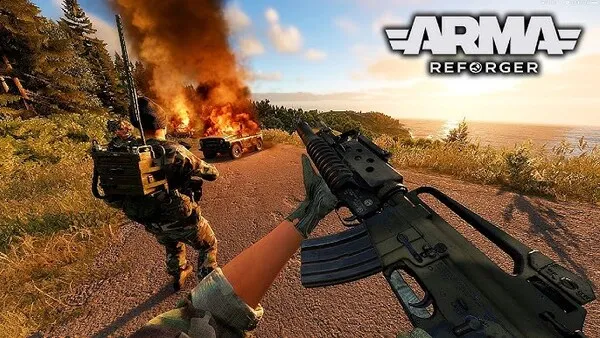
The opening phase of a Conflict match is often considered the most exciting period in Arma Reforger. At this stage, neither faction possesses extensive infrastructure. Players are still establishing forward operating bases, capturing objectives, and identifying enemy movements.
Because supply networks are not yet fully developed, mobility becomes the most valuable resource on the battlefield. Small squads can dramatically alter the course of the match by capturing remote objectives or disrupting enemy movements before defensive positions become established.
This stage rewards initiative. Players frequently improvise because there are few entrenched systems dictating how the battle should unfold. A single transport truck reaching the correct location at the right time can influence an entire region.
The uncertainty creates tension. Nobody knows where the main attack will develop, and every objective feels vulnerable.
Logistics Begin to Shape the Battlefield
As the match progresses, logistics gradually replace improvisation as the dominant strategic factor. Players begin establishing supply routes between key locations.
What initially appears to be a flexible battlefield starts developing predictable patterns. Trucks repeatedly travel between the same bases. Helicopters follow familiar routes. Reinforcements begin arriving through increasingly efficient channels.
This transformation is logical. Real military organizations rely on logistics because sustained operations require consistency. Reforger successfully simulates this reality.
The problem is that successful logistics networks tend to become self-reinforcing. The more established a route becomes, the easier it is to maintain. The easier it is to maintain, the more valuable it becomes.
This creates a cycle that gradually concentrates activity around specific corridors.
Successful Teams Build Momentum That Becomes Difficult to Break
One of the most common experiences in long Conflict matches is witnessing one faction gradually accumulate logistical superiority.
At first, the advantage may appear small. Perhaps one team captures a strategic road junction earlier. Perhaps they establish a forward base closer to contested territory. Perhaps they simply coordinate transport more effectively.
Over time, these small advantages compound.
Every successful supply delivery improves operational efficiency. Every operational improvement increases territorial control. Every territorial gain creates additional logistical opportunities.
The result is a feedback loop.
Instead of warfare remaining fluid, momentum begins favoring whichever faction established the stronger logistical network during the earlier phases of the match.
The Frontline Starts to Harden
As supply systems mature, frontlines become increasingly resistant to change.
Initially, objectives may change ownership multiple times within an hour. Later in the match, the same objectives can remain contested for extended periods despite repeated attacks.
This occurs because defenders benefit from established infrastructure.
When attackers lose personnel, vehicles, and supplies, they often need to transport replacements from greater distances. Defenders, meanwhile, can frequently draw resources from nearby logistical hubs.
The difference may only be a few kilometers.
In Arma Reforger, however, a few kilometers can represent significant travel time, coordination effort, and operational risk.
As a result, defense gradually becomes more efficient than offense.
The Reinforcement Advantage
The logistical advantage of defense manifests in several ways:
- Faster troop replacement.
- Shorter transportation routes.
- More consistent ammunition supply.
- Better vehicle availability.
- Reduced organizational burden.
Each factor appears minor individually.
Together they can significantly influence battlefield outcomes.
Strategic Creativity Begins to Decline
One of the most surprising consequences of mature supply networks is the reduction of strategic experimentation.
Early in a match, commanders and squad leaders frequently attempt unconventional operations. They explore alternate routes, conduct flanking maneuvers, and establish unexpected positions.
Later, these options become less attractive.
Why?
Because existing supply lines already support known approaches.
Players naturally gravitate toward areas where logistical support exists. Launching operations outside these established networks often requires additional transportation, communication, and coordination.
As a result, teams repeatedly fight over the same objectives using similar approaches.
The battlefield remains large, but strategic diversity can begin shrinking.
The Psychological Effect of Logistics Is Often Ignored
Most discussions about logistics focus on practical consequences.
The psychological impact receives far less attention.
When players repeatedly witness attacks failing against entrenched positions, they gradually alter their expectations. Teams become more cautious. Risk tolerance decreases.
Instead of attempting ambitious offensives, players often prefer reinforcing existing gains.
This behavior is rational.
Nobody wants to spend twenty minutes transporting supplies only to lose everything during an unsuccessful attack.
Unfortunately, rational decision-making can sometimes produce less dynamic gameplay.
The battlefield becomes increasingly conservative.
Why Players Avoid Risk
Several psychological factors contribute:
- Fear of wasting logistical effort.
- Long travel times after death.
- Attachment to established bases.
- Confidence in defensive positions.
- Uncertainty about offensive success.
These factors encourage preservation rather than expansion.
Vehicles Become Victims of the Same Problem
Vehicle gameplay suffers from similar dynamics.
In theory, Reforger's vehicles support mobility and battlefield flexibility. Trucks, armored vehicles, and helicopters should enable rapid operational shifts.
In practice, mature supply networks often dictate vehicle usage.
Instead of exploring new opportunities, vehicles frequently become dedicated logistics tools.
Transport routes become repetitive.
Helicopter pilots fly identical resupply missions.
Truck drivers repeat familiar journeys.
Armor units remain concentrated around predictable objectives.
The vehicles themselves remain enjoyable, but their strategic role becomes increasingly constrained by the logistical structure surrounding them.
Large Servers Magnify the Issue
The logistics problem becomes even more apparent on highly populated servers.
With greater player counts comes greater efficiency.
Large teams can maintain multiple supply routes simultaneously. They can continuously repair infrastructure and reinforce contested positions.
This creates impressive realism.
It also creates resilience.
The stronger the logistical system becomes, the harder it becomes to disrupt.
Small squads that might have influenced the battle earlier now struggle to produce meaningful strategic impact.
Their actions matter tactically but not always operationally.
As a result, some players feel that individual initiative becomes less influential during the later stages of large-scale matches.
Why Complete Removal of Logistics Would Be a Mistake
Despite these criticisms, logistics should not be removed or drastically simplified.
In fact, logistics are one of the primary reasons Arma Reforger stands apart from conventional shooters.
Without supply systems, territorial control would feel meaningless.
Without transportation requirements, vehicles would lose much of their purpose.
Without resource management, strategic planning would become significantly less important.
The goal is not to eliminate logistics.
The goal is to prevent logistics from becoming so stable that they reduce strategic flexibility.
A healthy battlefield requires both persistence and disruption.
Too much disruption creates chaos.
Too much persistence creates stagnation.
The challenge lies in balancing the two.
The Future of Conflict Depends on Dynamic Logistics
The most effective solution may not involve weakening logistics but making logistics more vulnerable and dynamic.
Supply networks should remain powerful, but maintaining them should require continuous adaptation.
Players should feel rewarded for discovering new routes, disrupting enemy transportation, and creating operational surprises.
Ideally, logistics would become a source of ongoing strategic decision-making rather than a solved problem.
When supply systems remain dynamic, frontlines remain dynamic.
When frontlines remain dynamic, player decisions retain their significance throughout the entire match.
The strongest Conflict experiences already demonstrate this principle. The most memorable battles are rarely the ones where supply networks function perfectly. They are the ones where logistics collapse, adapt, recover, and evolve under pressure.
Those moments create stories.
Those stories create memorable warfare.
Conclusion
Arma Reforger's logistics system represents one of the most ambitious and successful attempts to simulate military operations in a multiplayer environment. It transforms transportation, supply management, and territorial control into meaningful gameplay systems rather than background mechanics.
Yet this same strength can produce an unexpected weakness. As supply networks mature, they often create strategic inertia. Frontlines harden, offensive operations become increasingly difficult, and players gravitate toward established patterns of behavior.
The issue is not that logistics exist. The issue is that successful logistics can become too successful.
When supply routes become permanent, warfare becomes predictable. When warfare becomes predictable, the freedom that defines Arma Reforger begins to narrow.
The future of Conflict may therefore depend not on stronger logistics or weaker logistics, but on more dynamic logistics—systems that reward adaptation as much as efficiency. If that balance can be achieved, Reforger will continue delivering the large-scale military sandbox experience that makes it unique while preserving the unpredictability that keeps players returning match after match.